


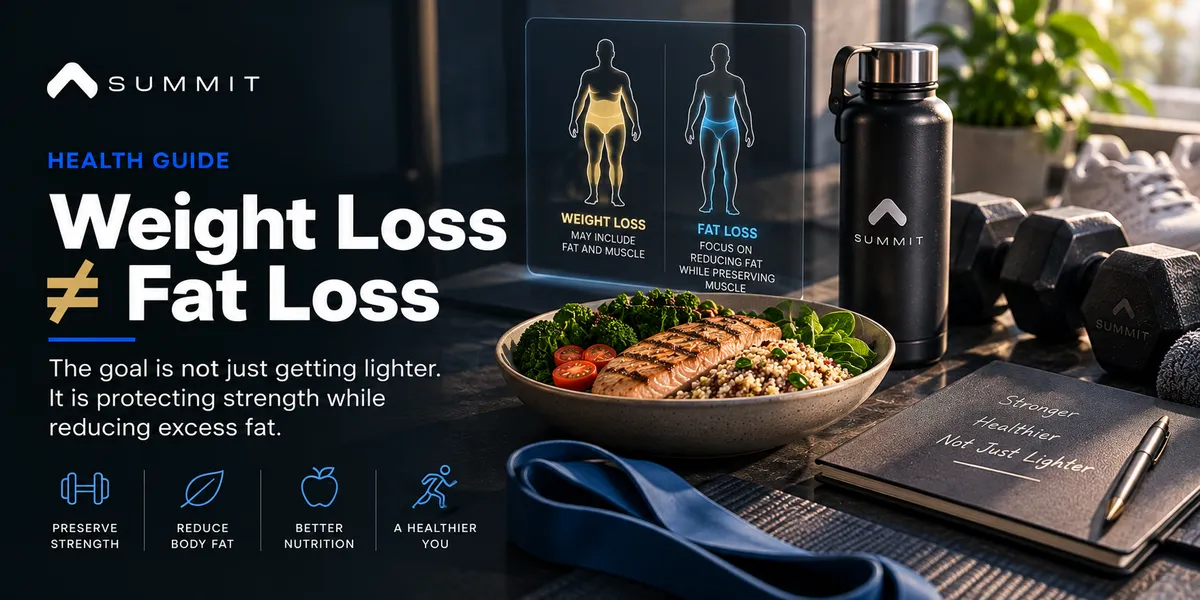
Weight Loss Does Not Always Mean Fat Loss
You can lose weight and still lose more muscle than you wanted.
Imagine you are sitting in a SUMMIT consultation. You step on the scale and the number has dropped.
Great news, right? Maybe. But we would probably ask another question:
What did you actually lose?
Because when body weight decreases, everything that disappears from the scale is not necessarily body fat. Weight loss can include changes in fat mass, lean tissue, and body water. That distinction becomes especially important when someone is experiencing substantial weight reduction with GLP 1 based therapy.
First, What Are You Actually Trying to Lose?
Most people say they want to lose weight.
What they usually mean is: I want to reduce excess body fat while staying strong and healthy.
Those are different goals. Your scale measures total body weight. It cannot tell you whether a change came from fat, lean tissue, water, or a combination. That is why body composition can tell a more meaningful story than weight alone.
THE SUMMIT TAKE
The goal is not simply to become lighter. It is to improve health while maintaining strength and function.
A lower number on the scale can be useful, but it should not automatically become the only definition of successful weight care.
What Happens During GLP 1 Based Weight Loss?
Research from pharmacological weight management programs helps explain why body composition deserves attention. Body composition analysis from the SURMOUNT program found that tirzepatide treatment reduced both fat mass and lean mass, with substantially more of the weight reduction coming from fat. Studies involving semaglutide have also documented reductions in fat mass alongside changes in lean mass during weight treatment. There is an important nuance here.
Lean mass is not exactly the same thing as muscle.
Lean mass measurements can include body water and other nonfat tissues. Researchers therefore caution against automatically interpreting every decline in lean mass as loss of functional skeletal muscle.
What Would We Ask During Your Consultation?
Instead of simply celebrating a lower scale reading, we might ask:
Are you feeling stronger or weaker?
Are you getting enough protein and overall nutrition?
Are you doing any resistance exercise?
Has your energy changed?
Can you perform the activities that matter to you?
Are we monitoring more than your weight?
Those questions turn weight treatment into a conversation about health rather than simply numbers.
YOUR SUMMIT CHECK IN
Ask yourself: If the scale disappeared tomorrow, how would I know my treatment was working?
Maybe your clothes fit differently.
Maybe movement feels easier.
Perhaps your waist measurement has changed.
Or you may notice that you feel stronger and more capable.
Those outcomes deserve attention too.
Why Resistance Training Matters
If preserving muscle is part of the goal, your muscles need a reason to stay active. Resistance exercise creates that signal. That might involve appropriately selected weights, resistance bands, machines, or body weight exercises depending on your health, mobility, and experience. Recent systematic evidence suggests that incorporating resistance training into weight management can improve lean mass preservation compared with weight reduction approaches without it. The right exercise approach should still reflect your individual health and abilities.
What About Protein?
Protein provides amino acids that your body uses to maintain and repair muscle tissue. But GLP 1 therapy can reduce appetite significantly for some people. When eating less, it becomes important to make sure that reduced food intake does not unintentionally mean inadequate nutrition. There is no universal protein target that is appropriate for everyone. Your needs can differ based on body size, activity, age, kidney health, medical history, and other factors. A clinician or qualified nutrition professional can help determine what is appropriate for you.
WHAT THIS DOES NOT MEAN
GLP 1 medications automatically cause unhealthy muscle loss.
Weight reduction through many different approaches can involve some loss of lean tissue. Current research suggests GLP 1 based therapies can produce substantial reductions in body fat, while the amount and clinical importance of lean tissue change can vary.
The better question is not: Will I lose any lean mass?
It is: How can my care plan support healthier body composition, strength, nutrition, and function while I lose weight?
FAQs
Q. Is weight loss the same as fat loss?
No. Weight loss describes a reduction in total body weight. Fat loss specifically refers to reducing body fat.
Q. Can GLP 1 therapy reduce lean mass?
Body composition studies have documented reductions in both fat mass and lean mass during some GLP 1 based weight loss programs.
Q. Can exercise help preserve muscle?
Resistance exercise provides an important stimulus for maintaining muscle during weight reduction and should be considered according to individual ability and clinical guidance.
Q. Is protein important during GLP 1 therapy?
Adequate nutrition and protein intake are important considerations when appetite and overall food intake decrease. Individual requirements should be personalized.
Q. Measure Progress beyond the Scale
Successful weight care should not simply ask:
Q. How much weight did you lose?
It should also ask:
Q. What happened to your body composition, strength, nutrition, movement, and overall health along the way?
At SUMMIT, that is where clinically guided Weight Health care can become more meaningful.


